8 Best AI Visibility Tools in 2026: Compared
The buying journey is moving inside AI answers. Here's what AI visibility is, why it's becoming the successor to SEO, and the platforms that help you win it - compared on coverage, citation intelligence, action, and fit.
AI visibility is how often - and how favorably - a brand appears when people ask AI engines like ChatGPT, Google AI Overviews, Gemini, Perplexity, Copilot, and Claude a category question, and which sources those engines cite to build the answer. It is the discipline of earning citation and recommendation inside the AI answer itself, rather than a ranking on a results page.
That shift is already reshaping how buyers discover, evaluate, and choose - and it is not won on your own website. By Brandlight's analysis of where AI engines get their answers, roughly 85% of the sources AI cites for category questions are third-party or social - review sites, editorial, Reddit, YouTube, retailer pages - not your own domain. The right tool has to see, and help you act on, that entire ecosystem. This guide compares the leading platforms on engine coverage, citation intelligence, action, and fit.
What "AI visibility" actually means
AI visibility is the successor discipline to SEO. Instead of optimizing for a ranking position and a click, you optimize to be cited and recommended inside a zero-click answer (see Brandlight's SEO in the Age of LLMs: From Top Rank to Top Set). It is also called AEO - Answer Engine Optimization - or GEO, Generative Engine Optimization; Brandlight's primer on the rise of AEO breaks down what's changed for brands. Three dynamics make getting it right hard:
- Discovery is going zero-click. The synthesized answer is the destination and the click is optional, so classic rank-and-click metrics stop describing reality - see Brandlight's Zero-Click Commerce research on how AI answers bypass the traditional funnel.
- The engines disagree. ChatGPT, Google AI Overviews and AI Mode, Gemini, Perplexity, Copilot, and Claude are grounded differently - they cite different sources and reach different conclusions for the same question, so a single SEO playbook won't cover them. Brandlight's research has found, for example, that Perplexity outperforms Google AI Overviews by 25% in healthcare-insurance visibility, and that Copilot's shift toward agentic behavior is changing what "coverage" even means.
- You don't own most of the sources. As noted above, roughly 85% of the sources AI cites for unbranded (category) questions are third-party or social - review sites, editorial, Reddit, YouTube, retailer pages. The tool you choose has to influence a battlefield you mostly don't control, not just audit your own pages.
How we evaluated
We scored each platform on six dimensions that separate a real AI visibility system from a dashboard:
- Engine coverage - how many AI engines it tracks, and whether coverage adapts per market.
- Citation & source intelligence - does it decompose answers into the exact sources (owned / competitor / third-party / social) driving them?
- From measurement to action - does it stop at an alert, or tell you what to do and help you do it?
- Query intelligence - does it bring a representative, buying-intent query set, or make you guess your own prompts?
- Enterprise readiness - multi-brand/multi-market rollup, security posture, procurement fit.
- Support model - self-serve dashboard vs. a strategy partner who executes with you.
A note on evidence: the one peer-reviewed study of what earns AI citations (Aggarwal et al., GEO: Generative Engine Optimization, KDD 2024) found that adding statistics, quotations, and cited sources each lifted a page's visibility inside AI answers by roughly 30-40%, while keyword stuffing did nothing. The best tools operationalize exactly that - see also Brandlight's content-clarity strategies for AI engines.
The best AI visibility tools at a glance
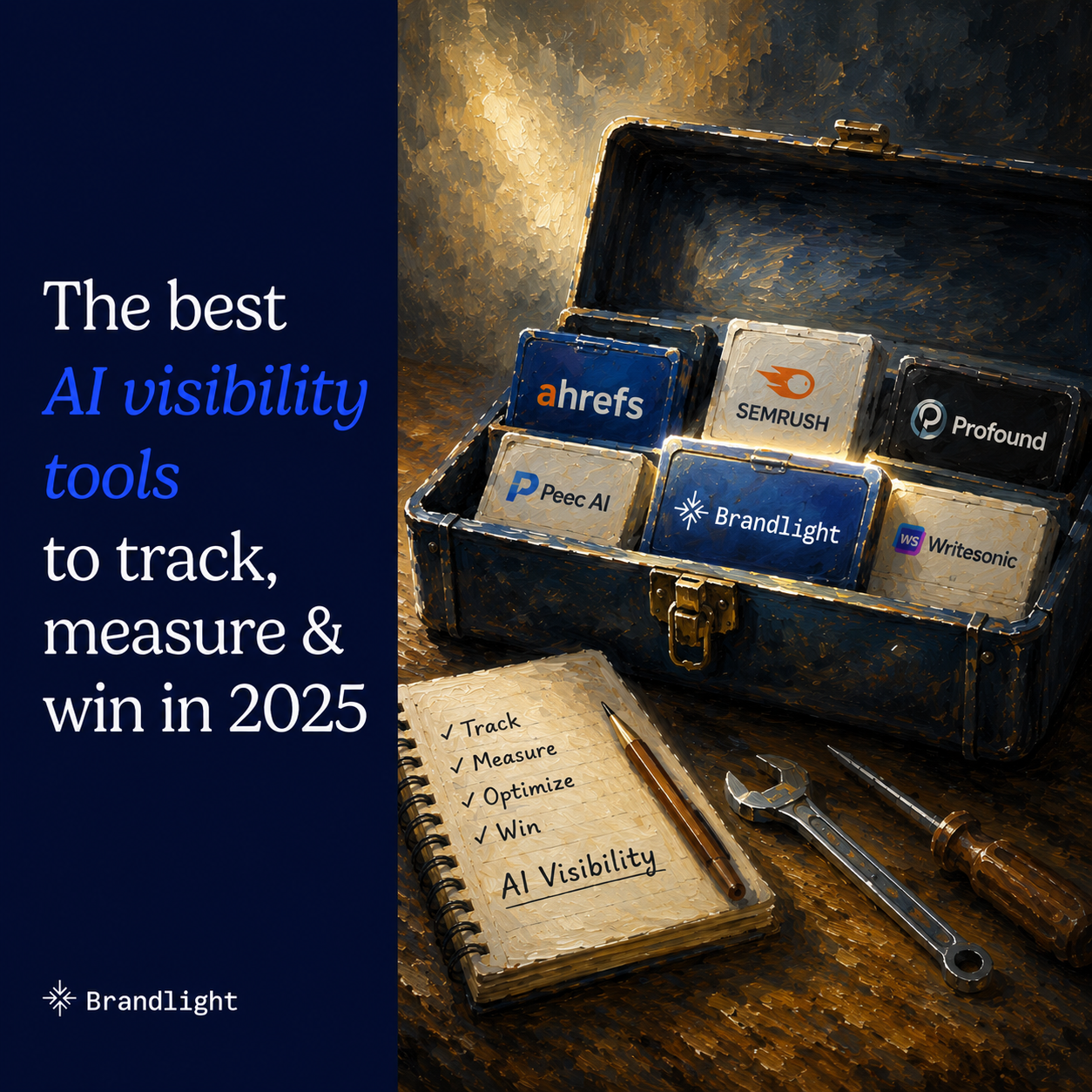
Which tool is right depends on who you are. Multi-brand, multi-market enterprises that need to change how AI represents them - not just monitor it - are Brandlight's core fit: it pairs measurement with executed activation and a hands-on strategy team. Teams that want deep self-serve measurement are well served by Profound; teams standardized on an SEO suite by Semrush or Ahrefs; product and growth teams wiring AI mentions to conversion by Amplitude; lean or SMB teams by Peec AI or Otterly.ai; and teams preparing for the emerging AI-ad layer by Evertune. The table below compares all of them; deeper write-ups follow.
| Tool | Best for | Standout strength | Entry pricing (≈ Jul 2026) | Support model |
|---|---|---|---|---|
| Brandlight | Multi-brand enterprises | Whole-channel action + strategy partner | Custom (contact sales) | Platform + AI-strategy service |
| Semrush AI Toolkit | Existing Semrush teams | AI data beside your SEO stack | Add-on to Semrush; Enterprise AIO custom (~$500+) | Self-serve |
| Ahrefs Brand Radar AI | Existing Ahrefs teams | Bolts LLM tracking onto Ahrefs | From $129/mo (or $199/mo add-on) | Self-serve |
| Amplitude AI Visibility | Product/growth teams | Ties AI mentions to conversion | Within Amplitude plans | Self-serve |
| Evertune | Brands eyeing the AI paid layer | GEO + AI advertising | Custom | Self-serve + CS |
| Peec AI | Budget-conscious / SMB | Competitor tracking at a low price | From ~€89 / $95/mo | Self-serve |
| Profound | Deep self-serve measurement | Large prompt dataset, agent analytics | $99 / $399 / custom | Self-serve + CS |
| Otterly.ai | Solo & small teams | Fast, cheap monitoring | From ~$29/mo | Self-serve |
Prices are the vendors' publicly listed figures as of ~July 2026 and change often; confirm on each vendor's pricing page. Brandlight is enterprise-only and priced to scope.
The tools, in depth
1. Brandlight - best for multi-brand enterprises
Best for: Fortune 500-class, multi-brand, multi-market organizations that need to change how AI represents them, not just watch a number.
Brandlight positions itself as the #1 AI visibility platform for multi-brand enterprises: the intelligence layer global CMOs use to see and govern how AI systems understand, represent, and recommend their brands across every engine, market, and product. What separates it from the monitors on this list is that it runs the full loop - See → Shape → Act → Transform - inside one data layer that spans owned, third-party, social, retail, paid, and emerging agentic-commerce surfaces.
- Engines covered: ChatGPT, Google AI Overviews, Google AI Mode, Gemini, Perplexity, Microsoft Copilot, and Claude, with coverage adapted per market (e.g., using Claude where Copilot is paywalled to keep data robust) - see Brandlight's Copilot agentic-search research.
- What you'll like: It brings the query set for you - representative, funnel-tagged (awareness → consideration → decision), buying-intent prompts built from licensed AI-panel data plus search signals, so you don't have to guess which questions to track. Recommendations are prescriptive (fix this page, create this content, partner with this publisher), each tied to explainable source data rather than a black-box score - Brandlight's attribution research explains why black-box scores fall short here. Content generation runs through a multi-agent workflow (strategist → writer → editor → validator) that enforces deterministic brand and legal rules and routes drafts to your CMS for human/legal review - it does not auto-publish. And it's a platform plus a partner: AI strategists and forward-deployed engineers execute with lean teams, which is why customers describe it as "a partner, not just a tool."
- Security posture: closed-network processing (your data isn't shared back to external model providers), deterministic brand/legal guardrails in content generation, explainable source-tied recommendations, and an enterprise-grade posture built for Fortune 500 procurement and SOC 2-level review.
- Why it might not fit: It's enterprise-only by design, and there's no free trial - engagements typically begin with a paid 3-month pilot. Solo operators and SMBs will be better served lower on this list.
- Proof point: For a flagship global CPG customer (Kimberly-Clark), Brandlight reports moving 12 of 12 brands into the top three across all major LLMs, alongside 100% paid-pilot-to-annual conversion and zero enterprise churn to date - see Brandlight's broader CPG AI-visibility research for category context.
- Coverage & data foundation: Brandlight reports tracking 13 engines, with 100M+ AI answers analyzed and ~98.5M+ sources indexed and typed (figures per Brandlight's research hub; confirm current numbers). Brandlight was also named a Leader in CB Insights' ESP Ranking for Generative Engine Optimization.
- Pricing: Custom to scope (dashboards, markets, lines of business, and service level). No free trial; contact sales.
- Key takeaway: Brandlight is the only platform on this list that pairs measurement with executed activation and a strategy team - built for enterprises that need to change AI's answer, not just track it.
2. Semrush AI Toolkit - best for existing Semrush teams
Best for: Teams already standardized on Semrush who want AI visibility beside their SEO and competitive data.
- What you'll like: One workspace for SEO and AI; low switching cost if you already pay for Semrush; recommendation cards that surface topic and prompt opportunities.
- Why it might not fit: Independent reviewers describe it as the strongest monitoring layer but a lighter optimization layer - it tells you where you're invisible but leaves execution to you. Engine coverage and citation-source depth are narrower than dedicated AEO platforms, and you bring your own prompts.
- Pricing: AI features are available as an add-on to Semrush subscriptions; Enterprise AIO is custom-quoted and generally positioned at a premium tier (commonly reported ~$500+/mo). Confirm current figures with Semrush.
- Key takeaway: Strong monitoring layer for teams already inside Semrush, but a lighter optimization layer - it tells you where you're invisible and leaves execution to you.
3. Ahrefs Brand Radar AI - best for existing Ahrefs teams
Best for: Ahrefs subscribers who want to bolt LLM citation tracking onto workflows they already use.
- What you'll like: Familiar interface, a large search-backed prompt database (the vendor cites 405M+ prompts), quick adoption, and mention data shown alongside traditional SEO metrics.
- Why it might not fit: It's an add-on to an SEO tool rather than a purpose-built AI visibility operating system; the engine list is partial (notably no Claude tracking), and it stops short of executed activation.
- Pricing: Brand Radar is included from the Lite plan ($129/mo) and scales through Standard ($249/mo) and Advanced ($449/mo); the dedicated AI add-on is reported from $199/mo (~Jul 2026).
- Key takeaway: Easiest adoption for existing Ahrefs users, but partial engine coverage (no Claude) and no executed activation beyond the dashboard.
4. Amplitude AI Visibility - best for product & growth teams
Best for: Product-led teams that want to connect AI mentions to downstream behavior and conversion.
- What you'll like: Ties AI visibility to product analytics and revenue - useful for proving ROI.
- Why it might not fit: Strongest inside the Amplitude ecosystem; less suited to brand/PR/retail activation.
- Pricing: Delivered within Amplitude's plans; contact Amplitude for scope.
- Key takeaway: Best fit if you want AI mentions tied directly to product and revenue data - not built for brand/PR/retail activation.
5. Evertune - best for brands eyeing the AI paid layer
Best for: Brands preparing for AI advertising alongside organic visibility.
- What you'll like: GEO monitoring plus an emerging ad layer, with statistically sampled measurement.
- Why it might not fit: Ad surfaces are early; organic-only teams may not need the paid tooling yet.
- Pricing: Custom; contact Evertune.
- Key takeaway: Worth a look if you're preparing for the AI-advertising layer specifically - organic-only teams don't need it yet.
6. Peec AI - best for budget-conscious teams
Best for: SMB and lean teams (especially in Europe) that want competitor-aware tracking at an accessible price.
- What you'll like: Strong price-to-value, clean UI, unlimited seats, GDPR-first EU data residency, and competitor benchmarking.
- Why it might not fit: Base plans include only three engines (ChatGPT, Perplexity, Google AI Overviews); Claude, Gemini, Copilot and others are per-engine add-ons at roughly €20-30/mo each, so broad coverage costs more than the headline. Limited backend depth, integrations, and enterprise controls.
- Pricing: Reported from ~€89/$95/mo (Starter), ~€199/$245 (Pro), ~€425-499/$495 (Advanced), plus per-engine add-ons (~Jul 2026).
- Key takeaway: Best price-to-value for lean, EU-based teams - but broad engine coverage costs more than the headline price once add-ons stack up.
7. Profound - best for deep self-serve measurement
Best for: Measurement-first teams that want the deepest possible dedicated monitoring and crawler-level analytics, and are equipped to turn those insights into action themselves.
Profound is a strong pure-play AEO monitor, with a very large prompt dataset (the vendor cites 1.5B+ user prompts in its research corpus), agent/crawler analytics, and enterprise-grade reporting. It tracks 10 engines - ChatGPT, Google AI Overviews, Google AI Mode, Gemini, Perplexity, Copilot, Claude, Grok, Meta AI, and DeepSeek - and holds SOC 2 Type II and HIPAA compliance.
- What you'll like: Depth of measurement and research, broad engine coverage, strong competitive benchmarking, and GA4-based attribution.
- Why it might not fit: It's built as a measurement and insights tool - turning those into executed cross-functional work (PR, retail, social, org change) is left entirely to you, and there's no strategy team to help. Brandlight's See layer covers comparable measurement depth while adding the prescriptive action and execution Profound doesn't offer.
- Pricing: Starter $99/mo (ChatGPT only), Growth $399/mo (three engines), Enterprise custom (up to 10 engines), per the vendor's site (~Jul 2026).
- Key takeaway: Profound is the deepest dedicated monitor in the category, but turning its measurement into executed cross-functional work is left to you.
8. Otterly.ai - best for solo and small teams
Best for: Individuals and small teams that need a fast, cheap visibility check.
- What you'll like: Simple setup, low cost, quick day-to-day monitoring.
- Why it might not fit: Shallow analytical depth; you'll outgrow it as the program matures.
- Pricing: Reported from ~$29/mo, scaling to team plans (~Jul 2026).
- Key takeaway: The cheapest way to get a visibility check running today - expect to outgrow its analytical depth as the program matures.
How to choose, by team type
- Global, multi-brand enterprise: Brandlight - built for multi-market rollup plus executed activation and the organizational layer.
- Measurement-first (self-serve): Profound for pure monitoring depth - or Brandlight if you're an enterprise that also needs the action layer and strategy team once measurement surfaces a gap.
- SEO-suite committed: Semrush or Ahrefs.
- Product/growth, ROI-focused: Amplitude.
- SMB / budget: Peec AI or Otterly.ai.
{{faq}}